Concrete is one of the most durable building materials ever created. It supports skyscrapers, highways, foundations, sidewalks, and just about every modern structure imaginable. But that same toughness makes it difficult to modify once it’s in place. That’s where Concrete Cutting Detroit comes in. It’s the specialized service that allows existing concrete to be precisely cut, shaped, and modified, opening up countless possibilities for renovations, repairs, additions, and infrastructure changes.
This article takes a comprehensive look at concrete cutting, including the various methods used, where each technique excels, why precision matters, and how this service supports projects ranging from small home renovations to large commercial builds.
What Is Concrete Cutting?
Concrete cutting is the controlled process of making clean, precise cuts in concrete using specialized equipment. It allows contractors to create openings, remove damaged sections, install new utilities, or modify existing structures without the destructive effects of breaking the concrete with hammers or jackhammers.
Most modern concrete cutting relies on diamond-tipped tools. Diamond blades, wires, and core bits stay sharp longer, cut through reinforced concrete with ease, and produce clean edges that don’t require extensive finishing. Water is often used during cutting to cool the blade, reduce dust, and improve the working environment.
Why Concrete Cutting Matters
Anyone who has tried to break concrete with a sledgehammer knows it’s slow, messy, and imprecise. Cutting offers a far better alternative for situations that demand accuracy and minimal disruption.
Precision. Cutting produces straight, accurate edges that align with the design plans. This is essential for installing new doors, windows, or utility openings.
Less structural damage. Breaking concrete with impact tools can cause cracks and damage to surrounding areas. Cutting limits damage to the section being removed.
Faster completion. For many projects, cutting is significantly faster than traditional breaking methods, especially for large or thick concrete sections.
Cleaner work environment. Wet cutting controls dust, making it safer for workers and easier to manage in enclosed spaces.
Versatility. Concrete cutting can handle walls, floors, ceilings, slabs, columns, and curved surfaces, making it applicable to almost any concrete project.
Common Concrete Cutting Methods
Different situations call for different cutting techniques. Here are some of the most widely used methods and where they shine.
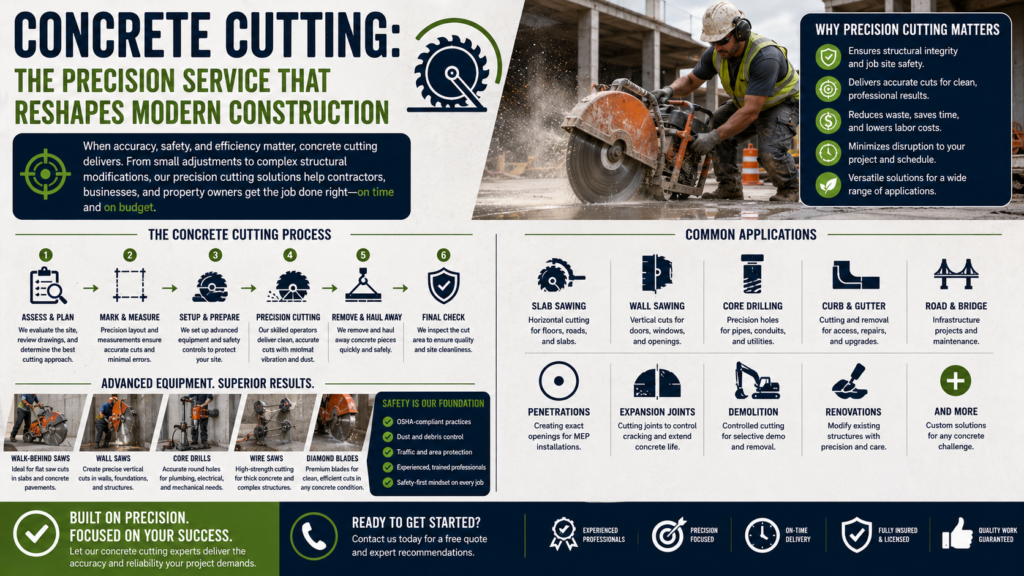
Slab sawing. Also known as flat sawing, this method uses a walk-behind saw with a diamond blade to cut horizontal surfaces like floors, sidewalks, driveways, and bridge decks. It’s ideal for creating expansion joints, removing damaged sections, or preparing surfaces for new installations.
Wall sawing. A track-mounted saw with a circular blade is used to cut vertical surfaces such as walls. It’s commonly used for creating door and window openings, HVAC penetrations, and other openings in existing concrete walls. The track system allows for precise, controlled cuts that wouldn’t be possible with handheld equipment.
Core drilling. This method uses cylindrical diamond-tipped drill bits to create precise round holes in concrete. It’s used for plumbing penetrations, electrical conduits, HVAC openings, and anchor holes. Core drilling produces clean, exact openings without damaging surrounding concrete.
Wire sawing. A diamond-impregnated cable is looped around large sections of concrete and pulled through, much like a band saw on a massive scale. Wire sawing is used for cutting thick or heavily reinforced concrete, large structural elements, and situations where other methods can’t reach. It’s often used in bridge work, dam projects, and industrial demolition.
Hand sawing. Handheld concrete saws are used for smaller cuts, tight spaces, or finishing work. They offer flexibility but are typically used for less demanding tasks.
Ring sawing. A specialized saw with a ring-shaped blade allows deeper cuts in tight spaces. It’s useful for plunge cuts and irregular shapes.
Chain sawing. Similar to a chainsaw but designed for concrete, this tool is used for sharp angles, square corners, and deep cuts in confined areas.
Wet vs. Dry Cutting
Most concrete cutting is done either wet or dry, depending on the location and the situation.
Wet cutting uses water to cool the blade and suppress dust. It’s common indoors and in confined spaces because it dramatically reduces airborne silica, which can be a serious health hazard.
Dry cutting is used outdoors and in well-ventilated areas. It’s faster for some applications but generates significant dust, requiring proper protective equipment and dust control measures.
Common Applications for Concrete Cutting
Renovation and remodeling. Adding windows, doors, vents, or doorways in existing concrete structures requires precise cutting.
Plumbing and electrical work. New plumbing lines, electrical conduits, or HVAC ducts often need to pass through concrete slabs or walls.
Sidewalk and driveway repair. Damaged sections are cut out and replaced with clean edges that bond well with new concrete.
Expansion joints. Slab sawing creates expansion joints that allow concrete to expand and contract without uncontrolled cracking.
Pool and patio installation. Concrete cutting helps prepare and modify outdoor surfaces during landscape construction.
Bridge and infrastructure work. Wire sawing and other methods support major infrastructure projects.
Industrial modifications. Manufacturing facilities, warehouses, and commercial buildings often need to modify existing concrete to accommodate new equipment or layouts.
Safety Considerations
Concrete cutting comes with real hazards. Silica dust exposure, equipment-related injuries, and electrical risks from contact with embedded conduits all need to be addressed.
Professional crews use protective equipment including respirators, eye protection, hearing protection, and proper clothing. They also rely on dust control measures, locate scans to identify embedded utilities, and proper equipment maintenance to keep things safe.
Before any cutting begins, scanning the concrete for embedded utilities, post-tension cables, or rebar is a critical step. Cutting into the wrong material can cause structural problems, electrical hazards, or even injuries.
Common Questions About Concrete Cutting
How thick of concrete can be cut? Different methods handle different thicknesses. Slab saws can cut up to about 30 inches, while wire sawing can handle much thicker sections. The right tool depends on the job.
Can rebar be cut along with concrete? Yes. Diamond blades are designed to cut through both concrete and the steel rebar inside it.
Will cutting cause cracks in the surrounding concrete? Properly performed cutting is precise and limits stress on the surrounding material. Poor technique or wrong equipment can cause damage, which is why professional cutting is so important.
How is dust controlled? Wet cutting suppresses dust with water. Dry cutting requires vacuums, ventilation, and respiratory protection.
Is concrete cutting noisy? Yes. Cutting generates significant noise, and hearing protection is a must. Most cutting jobs are scheduled to minimize disruption to neighbors and occupants.
Why Detroit Properties Often Need Concrete Cutting
Detroit’s mix of historic buildings, industrial facilities, and ongoing development means concrete cutting is in constant demand. Older buildings being modernized, new openings in existing walls, utility upgrades, and infrastructure improvements all require precise concrete modification. Professional Concrete Cutting Detroit services support these projects with the equipment and expertise needed to make clean, accurate cuts in everything from sidewalks to commercial structures.
The Big Picture
Concrete cutting is one of those services that quietly makes modern renovation, repair, and construction possible. Without it, modifying existing concrete structures would be slow, destructive, and often impractical. With it, contractors can make precise changes that preserve the surrounding structure while opening up entirely new possibilities.
Whether the project is small, like adding a vent through a concrete wall, or large, like cutting expansion joints across a major slab, the principles are the same: precision, safety, and respect for the material. Concrete is strong because it’s meant to be, and working with it requires the right tools and the right knowledge.
For property owners considering any project that involves modifying existing concrete, understanding the basics of concrete cutting helps set realistic expectations and ensures the work is done in a way that protects both the structure and the people involved.
Concrete is one of the most durable building materials ever created. It supports skyscrapers, highways, foundations, sidewalks, and just about every modern structure imaginable. But that same toughness makes it difficult to modify once it’s in place. That’s where concrete cutting comes in. It’s the specialized service that allows existing concrete to be precisely cut, shaped, and modified, opening up countless possibilities for renovations, repairs, additions, and infrastructure changes.
This article takes a comprehensive look at concrete cutting, including the various methods used, where each technique excels, why precision matters, and how this service supports projects ranging from small home renovations to large commercial builds.
What Is Concrete Cutting?
Concrete cutting is the controlled process of making clean, precise cuts in concrete using specialized equipment. It allows contractors to create openings, remove damaged sections, install new utilities, or modify existing structures without the destructive effects of breaking the concrete with hammers or jackhammers.
Most modern concrete cutting relies on diamond-tipped tools. Diamond blades, wires, and core bits stay sharp longer, cut through reinforced concrete with ease, and produce clean edges that don’t require extensive finishing. Water is often used during cutting to cool the blade, reduce dust, and improve the working environment.
Why Concrete Cutting Matters
Anyone who has tried to break concrete with a sledgehammer knows it’s slow, messy, and imprecise. Cutting offers a far better alternative for situations that demand accuracy and minimal disruption.
Precision. Cutting produces straight, accurate edges that align with the design plans. This is essential for installing new doors, windows, or utility openings.
Less structural damage. Breaking concrete with impact tools can cause cracks and damage to surrounding areas. Cutting limits damage to the section being removed.
Faster completion. For many projects, cutting is significantly faster than traditional breaking methods, especially for large or thick concrete sections.
Cleaner work environment. Wet cutting controls dust, making it safer for workers and easier to manage in enclosed spaces.
Versatility. Concrete cutting can handle walls, floors, ceilings, slabs, columns, and curved surfaces, making it applicable to almost any concrete project.
Common Concrete Cutting Methods
Different situations call for different cutting techniques. Here are some of the most widely used methods and where they shine.
Slab sawing. Also known as flat sawing, this method uses a walk-behind saw with a diamond blade to cut horizontal surfaces like floors, sidewalks, driveways, and bridge decks. It’s ideal for creating expansion joints, removing damaged sections, or preparing surfaces for new installations.
Wall sawing. A track-mounted saw with a circular blade is used to cut vertical surfaces such as walls. It’s commonly used for creating door and window openings, HVAC penetrations, and other openings in existing concrete walls. The track system allows for precise, controlled cuts that wouldn’t be possible with handheld equipment.
Core drilling. This method uses cylindrical diamond-tipped drill bits to create precise round holes in concrete. It’s used for plumbing penetrations, electrical conduits, HVAC openings, and anchor holes. Core drilling produces clean, exact openings without damaging surrounding concrete.
Wire sawing. A diamond-impregnated cable is looped around large sections of concrete and pulled through, much like a band saw on a massive scale. Wire sawing is used for cutting thick or heavily reinforced concrete, large structural elements, and situations where other methods can’t reach. It’s often used in bridge work, dam projects, and industrial demolition.
Hand sawing. Handheld concrete saws are used for smaller cuts, tight spaces, or finishing work. They offer flexibility but are typically used for less demanding tasks.
Ring sawing. A specialized saw with a ring-shaped blade allows deeper cuts in tight spaces. It’s useful for plunge cuts and irregular shapes.
Chain sawing. Similar to a chainsaw but designed for concrete, this tool is used for sharp angles, square corners, and deep cuts in confined areas.
Wet vs. Dry Cutting
Most concrete cutting is done either wet or dry, depending on the location and the situation.
Wet cutting uses water to cool the blade and suppress dust. It’s common indoors and in confined spaces because it dramatically reduces airborne silica, which can be a serious health hazard.
Dry cutting is used outdoors and in well-ventilated areas. It’s faster for some applications but generates significant dust, requiring proper protective equipment and dust control measures.
Common Applications for Concrete Cutting
Renovation and remodeling. Adding windows, doors, vents, or doorways in existing concrete structures requires precise cutting.
Plumbing and electrical work. New plumbing lines, electrical conduits, or HVAC ducts often need to pass through concrete slabs or walls.
Sidewalk and driveway repair. Damaged sections are cut out and replaced with clean edges that bond well with new concrete.
Expansion joints. Slab sawing creates expansion joints that allow concrete to expand and contract without uncontrolled cracking.
Pool and patio installation. Concrete cutting helps prepare and modify outdoor surfaces during landscape construction.
Bridge and infrastructure work. Wire sawing and other methods support major infrastructure projects.
Industrial modifications. Manufacturing facilities, warehouses, and commercial buildings often need to modify existing concrete to accommodate new equipment or layouts.
Safety Considerations
Concrete cutting comes with real hazards. Silica dust exposure, equipment-related injuries, and electrical risks from contact with embedded conduits all need to be addressed.
Professional crews use protective equipment including respirators, eye protection, hearing protection, and proper clothing. They also rely on dust control measures, locate scans to identify embedded utilities, and proper equipment maintenance to keep things safe.
Before any cutting begins, scanning the concrete for embedded utilities, post-tension cables, or rebar is a critical step. Cutting into the wrong material can cause structural problems, electrical hazards, or even injuries.
Common Questions About Concrete Cutting
How thick of concrete can be cut? Different methods handle different thicknesses. Slab saws can cut up to about 30 inches, while wire sawing can handle much thicker sections. The right tool depends on the job.
Can rebar be cut along with concrete? Yes. Diamond blades are designed to cut through both concrete and the steel rebar inside it.
Will cutting cause cracks in the surrounding concrete? Properly performed cutting is precise and limits stress on the surrounding material. Poor technique or wrong equipment can cause damage, which is why professional cutting is so important.
How is dust controlled? Wet cutting suppresses dust with water. Dry cutting requires vacuums, ventilation, and respiratory protection.
Is concrete cutting noisy? Yes. Cutting generates significant noise, and hearing protection is a must. Most cutting jobs are scheduled to minimize disruption to neighbors and occupants.
Why Detroit Properties Often Need Concrete Cutting
Detroit’s mix of historic buildings, industrial facilities, and ongoing development means concrete cutting is in constant demand. Older buildings being modernized, new openings in existing walls, utility upgrades, and infrastructure improvements all require precise concrete modification. Professional Concrete Cutting Detroit services support these projects with the equipment and expertise needed to make clean, accurate cuts in everything from sidewalks to commercial structures.
The Big Picture
Concrete cutting is one of those services that quietly makes modern renovation, repair, and construction possible. Without it, modifying existing concrete structures would be slow, destructive, and often impractical. With it, contractors can make precise changes that preserve the surrounding structure while opening up entirely new possibilities.
Whether the project is small, like adding a vent through a concrete wall, or large, like cutting expansion joints across a major slab, the principles are the same: precision, safety, and respect for the material. Concrete is strong because it’s meant to be, and working with it requires the right tools and the right knowledge.
For property owners considering any project that involves modifying existing concrete, understanding the basics of concrete cutting helps set realistic expectations and ensures the work is done in a way that protects both the structure and the people involved.